
Practical resources. Better parts.
Clear guidance on materials, design, files, and ordering—so you can make confident decisions and get parts that perform.
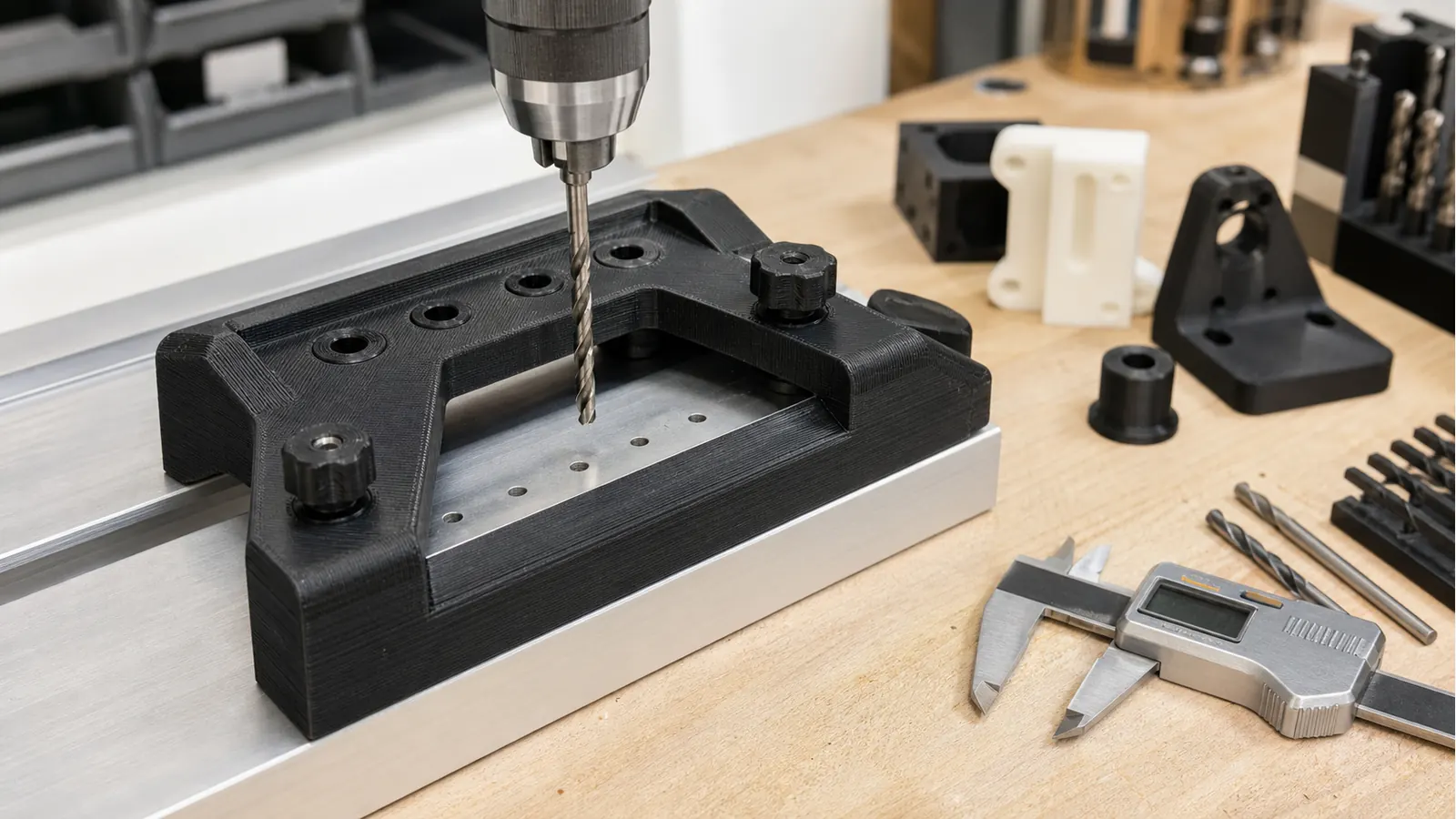
3D printing jigs for faster shop work
A good jig does not need to be beautiful. It needs to make the next operation easier, faster, and more repeatable. 3D printing is a strong fit when the jig is custom to one part, one tool, or one awkward setup.
Read the guideDesigning 3D printed fixtures for repeatability
A fixture earns its keep when it makes a result repeatable. For 3D printed fixtures, the biggest wins usually come from smart locating surfaces, material choice, stiffness, and a design that respects real shop handling.
Read guideCustom 3D printed brackets: what to decide before ordering
Custom 3D printed brackets are useful because they can match the exact space, hole pattern, and job. The best orders start with a few practical decisions about load, mounting, material, and fit.
Read guideWhen to choose PLA vs PETG for custom 3D printed parts
PLA and PETG cover a huge percentage of practical custom 3D printing jobs. The right choice usually comes down to whether the part is mainly about speed and clean detail or about toughness and real-world handling.
Read guideBrowse the library
Find the answer that moves your part forward.
Every guide is written around practical ordering decisions—what to send, what to expect, and where a different material or design choice may help.
Materials
Choose a material by real environment, handling, stiffness, and service life.
PLA and PETG cover a huge percentage of practical custom 3D printing jobs. The right choice usually comes down to whether the part is mainly about speed and clean detail or about toughness and real-world handling.
Read guide Best uses for carbon-fiber-filled 3D printing materialsCarbon-filled materials are attractive because they feel more technical, but the right reason to choose them is usually stiffness, dimensional stability, or a particular type of functional performance, not just the look.
Read guideDesign
Plan stronger geometry, practical clearances, and mounting details before export.
Custom 3D printed brackets are useful because they can match the exact space, hole pattern, and job. The best orders start with a few practical decisions about load, mounting, material, and fit.
Read guide How to design a strong FDM bracketA bracket is one of the easiest parts to get wrong in FDM because it looks simple in CAD. Strength usually comes from geometry choices like ribs, fillets, wall thickness, and load direction, not from wishful thinking about plastic.
Read guide How much tolerance should you add to a 3D printed part?The right answer depends on the part, but the bigger principle is simple: do not model a printed part like a perfect nominal machined fit and expect it to snap into reality without thought.
Read guideJigs and fixtures
Build repeatable shop aids around locating, access, wear, and daily handling.
A good jig does not need to be beautiful. It needs to make the next operation easier, faster, and more repeatable. 3D printing is a strong fit when the jig is custom to one part, one tool, or one awkward setup.
Read guide Designing 3D printed fixtures for repeatabilityA fixture earns its keep when it makes a result repeatable. For 3D printed fixtures, the biggest wins usually come from smart locating surfaces, material choice, stiffness, and a design that respects real shop handling.
Read guideFiles and ordering
Understand file types, lead time, quantity, and when printing is the practical process.
Both STEP and STL can work for ordering custom 3D printed parts. The better file is usually the one that matches where the design currently lives in your workflow and how much cleanup you want to do before uploading.
Read guide How fast can custom 3D printed parts ship?Speed is one of the biggest reasons customers choose 3D printing in the first place. The real answer depends on whether the part is straightforward, what material it needs, the quantity, and how complex the geometry is.
Read guide When 3D printing beats machining for low-volume partsMachining is not the enemy. It is just a different process with different economics and strengths. For low-volume plastic parts, 3D printing can win because it removes tooling setup, shrinks lead time, and handles custom geometry more easily.
Read guideProduction examples
See how custom parts solve real problems.
Short case studies showing where 3D printing helped with iteration, repeat work, and hard-to-source replacement parts.
This type of project is exactly where 3D printing makes sense: a product enclosure still moving in CAD, where the biggest value is learning fast from a real part in hand.
View case study Planning a fixture bracket for repeat workShop fixtures do not need to be glamorous to be valuable. A simple bracket or holding aid can save time every day, and that is exactly the kind of low-volume geometry-specific job 3D printing handles well.
View case study Planning a replacement cover for a legacy partLegacy replacement parts are one of the most practical uses for custom 3D printing. The goal is not novelty. The goal is getting something working again with a useful custom plastic part.
View case studyReady to make the part?