
Use it while a design is still changing or demand is still uncertain.
Low-volume 3D printing
Repeatable short runs without tooling delay.
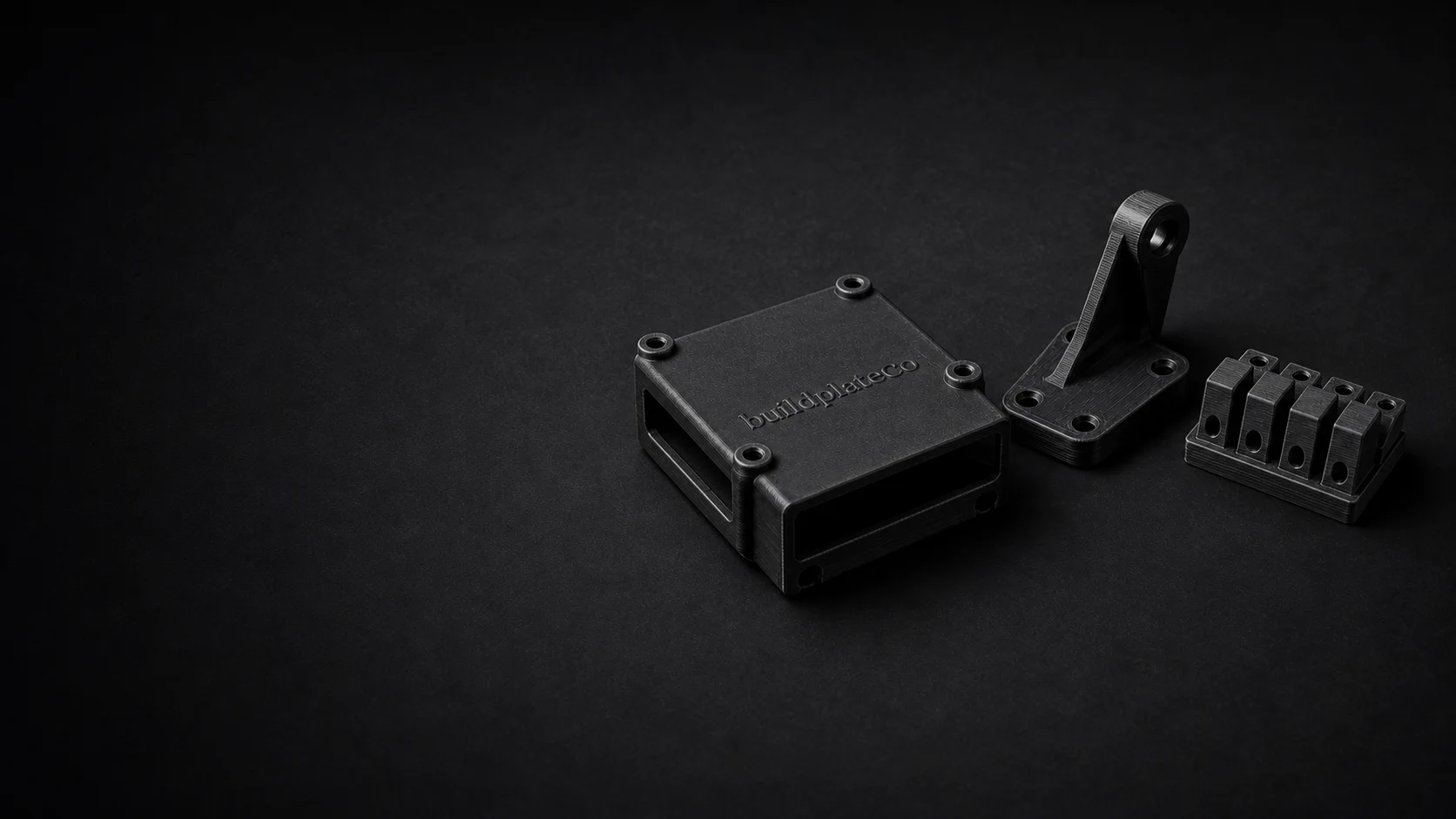
Make one part or a small production run without injection-molding tooling. BuildplateCo quotes custom FDM brackets, covers, adapters, and fixture components from your STL, STEP, or STP models. Compare quantities, approve the fit, and choose delivery before payment.
Print-ready STL, STEP, or STP files. CAD repair or model creation is paid work and priced before it begins.
01
Short-run friendly
A good fit for one-off jobs and modest batch quantities.
02
No production mold
You do not need a mold or tooling package to place a print order.
03
Custom geometry
Useful when each part is niche or hard to source.
04
Fast revisions
Design updates remain easy during early production or low-volume use.
Best use cases
When low-volume printing makes sense
A good fit for small multi-part orders, upgrade kits, or shop-use part sets.
Works well when the part only makes sense for a niche machine, product, or workflow.
Compare quantities
Price one part, five parts, and a small run
Use the same model, material, and settings for each comparison. Displayed quantity pricing reflects the geometry and production work; it is not a universal percentage discount.
| Quantity to try | Typical decision | Compare in the quote |
|---|---|---|
| 1 | Approve a prototype or replacement fit | Part price, critical dimensions, and any revision needed. |
| 5 | Pilot build, service kit, or several workstations | Per-part price and total for the approved version. |
| 25 | Small repeat installation or production run | Full batch price and production time; check shipping at checkout. |
Release the right version
Approve the part before multiplying it
Use a clear file name and revision for each component. Confirm mounting, assembly, and material requirements on a first sample before ordering copies.
A PLA fit check can be useful, but a material change can affect shrinkage, stiffness, and fit. Check the final geometry in the intended material.
Provide critical dimensions, cosmetic faces, service environment, and acceptance needs. Visible layer lines and orientation-dependent strength remain part of FDM production.
Good short-run candidates
Where low-volume printing earns its keep
Short-run printing works best when the cost of waiting, tooling, or sourcing is higher than the cost of printing the exact part needed. It is especially useful when the design may still change.
Order enough parts to assemble and test a small batch before committing to a larger production method.
Print niche spacers, covers, guides, and adapters that support maintenance or field work.
Make fixture sets, holders, organizers, and setup tools that improve repeat work without a formal tooling project.
Process choice
Compare the manufacturing method for the job
| Need | FDM can be useful | Also compare |
|---|---|---|
| Changing design or complex low-volume geometry | No production mold; straightforward file revisions | Machining if dimensional accuracy or finish dominates. |
| Niche covers, mounts, or fixtures | One-off parts and small batches from the supplied model | Available stock parts and total delivered cost. |
| Tight fits, sealing faces, or a machined finish | Review whether samples or secondary work can meet the requirement | A machining supplier with the required finish and tolerance. |
| Large stable production quantities | Compare the quoted total rather than assuming a crossover quantity | Molding tooling, amortized part cost, and minimum order commitments. |
Production and shipping
Use the full batch estimate to plan delivery
Review model-based part pricing and the total for each quantity. Print time, material, supports, and batch layout affect the result.
The quote shows the current production estimate. Production starts after payment, and larger quantities may need more machine time.
Enter the shipping destination at checkout for shipping cost and transit estimates. Carrier transit is additional to production; compare the delivered order total.
FAQ
Common questions before ordering.
What counts as low volume here?
The service is most comfortable with one-off parts and small short runs where tooling would not make sense.
Can short-run quantities still get better pricing?
Yes. Quantity breaks are shown during quoting so you can compare one-off and short-run options.
Is low-volume 3D printing a replacement for injection molding?
Not at high volume. It is usually a better fit before tooling, between design revisions, or when the part will never justify mold costs.
Can a low-volume order include several different parts?
Yes. Multi-part jobs can be uploaded and quoted together when the parts are ready as STL or STEP files.
Is there a fixed batch size or discount for low-volume printing?
There is no single batch size or discount that fits every model. Compare quantities of 1, 5, and 25 in the quote, or enter the quantity you need. The displayed totals and production estimate depend on geometry, material, settings, and production work.
Should I order a sample before a production run?
A first sample is useful when mating fit, assembly, heat, load, or appearance matters. Validate the actual model in the intended production material before duplicating it. A design or material change can require another check.
Can I reorder the same part later?
Your account retains quotes, order history, and saved files for reuse. Keep the approved revision and confirm the material, settings, current price, and production estimate when placing the next order.
Upload the file.
We’ll check the practical limits.
Review pricing before checkout, or request a scope review when the design still needs work. Any CAD work is separately priced before it begins.