
Name what it does: hold, cover, space, adapt, guide, protect, or replace.
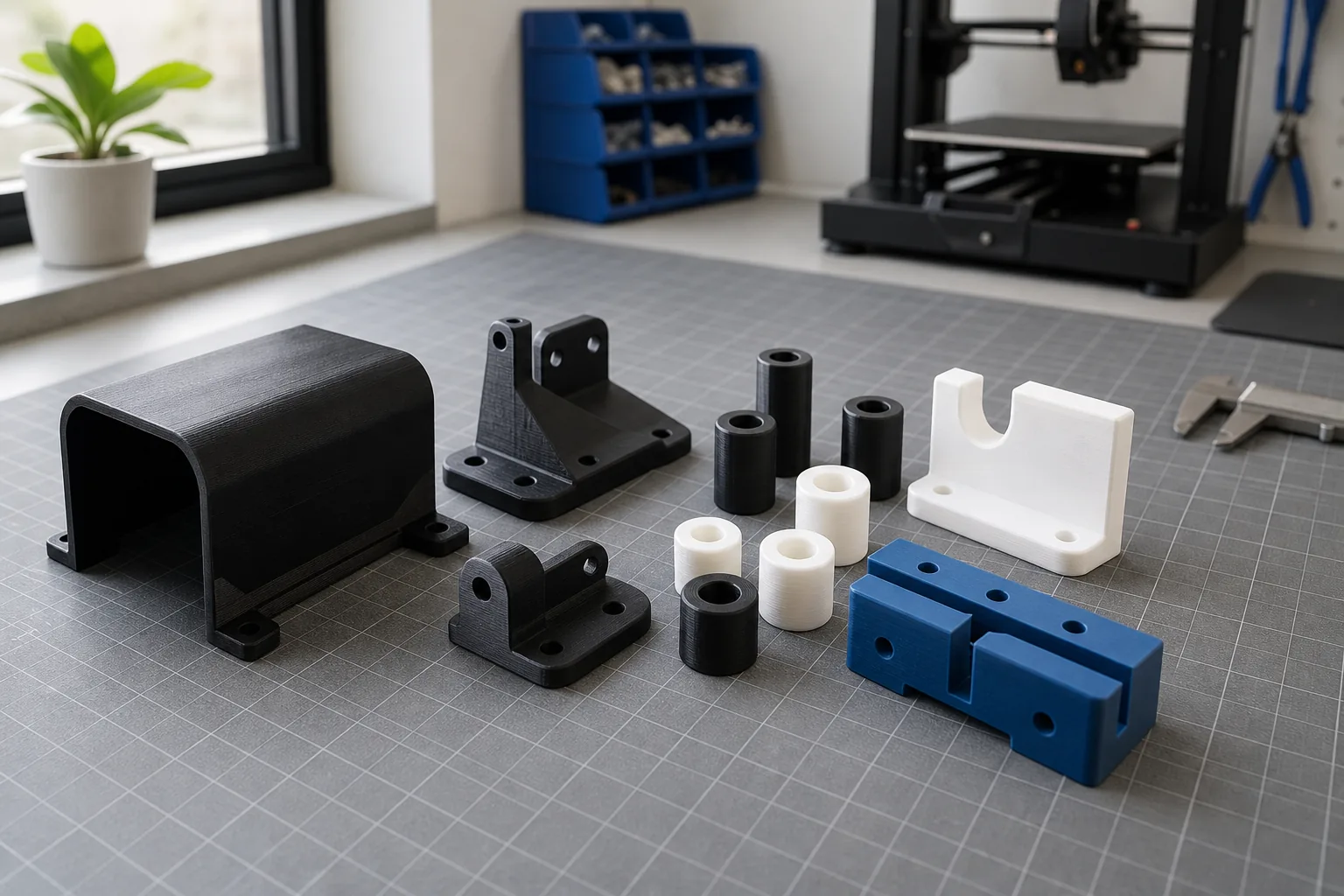
Custom plastic parts made
Get the custom plastic part made.
A useful custom part often starts with a plain-language need: a bracket, cover, spacer, adapter, holder, or small plastic component that does not exist off the shelf. Start with a print-ready file, or request a paid CAD estimate when geometry still needs to be created.
Print-ready STL, STEP, or STP files. CAD repair or model creation is paid work and priced before it begins.
Custom plastic parts are strongest when the design starts with the real use case: fit, load, environment, and quantity.
01
Best for
One-off brackets, covers, adapters, spacers, holders, fixtures, and small functional parts.
02
Good quantities
Single parts, prototypes, and low-volume batches where tooling does not make sense.
03
Starting point
Upload STL or STEP files, or send details if the part needs review first.
04
Key decision
The right material depends on the job, not just the part shape.
Choose based on heat, toughness, stiffness, appearance, and handling.
Upload a finished file for quoting, or send details before ordering if the design is not ready.
Common jobs
Custom plastic parts that fit this process well
3D printing is not the answer for every plastic part, but it is a strong path when the geometry is specific, the quantity is low, and the cost of tooling or sourcing would slow the project down.
Sensor mounts, utility brackets, holders, standoffs, and small machine-side supports.
Protective covers, bezels, guards, panels, and enclosure pieces.
Low-volume parts that bridge awkward fits, offsets, hole patterns, or old hardware.
Before you order
The details that make a custom part easier to quote
A custom part order gets better when the file is paired with a short description of what the part has to survive. The file gives shape; the notes explain risk.
- 01STL, STEP, or STP file if the model already exists
- 02Quantity target and whether this is a prototype, repair, or production helper
- 03Critical dimensions like hole spacing, wall thickness, and mating faces
- 04Environment notes: heat, outdoor exposure, load, vibration, water, or repeated handling
Where 3D printing is a good fit
Why low-volume custom plastic parts often make sense
The main advantage is speed and flexibility. You can make a useful one-off or short run without waiting for molds, tooling, or a supplier that only wants larger quantities.
Good when the part is too custom or too low-volume for molding.
If the first version teaches something, the file can be updated before the next order.
Ribs, bosses, holes, offsets, and brackets can be combined into one practical part.
Part intent
How to frame the request so the result is useful
The best custom plastic part requests explain the job in plain language before jumping into material names. A bracket that holds a sensor, a cover that keeps debris out, and a spacer that sets a gap all need different decisions.
Call out mating faces, hole spacing, screw clearance, tabs, bosses, and any features that must line up with another object.
Explain whether the part is decorative, hand-operated, clamped, screwed down, repeatedly flexed, or carrying weight.
Heat, sunlight, moisture, chemicals, and vibration can change whether PLA, PETG, PETG-CF, or PET-CF is the right starting point.
Before ordering
Quick decision guide.
- Strong use
- One-off or low-volume parts with specific geometry, clear fit needs, and practical plastic performance.
- Needs care
- High heat, heavy load, tight snap fits, cosmetic show surfaces, or unknown critical dimensions.
- Send with the file
- Printable file, use-case notes, quantity, important dimensions, and material/environment expectations.
FAQ
Common questions before ordering.
Can you make just one custom plastic part?
Yes. One-off and low-volume custom plastic parts are a strong fit for this service.
Do I need to know the exact material?
No. You can start with the use case, compare material pages, or ask for help before ordering.
What file type should I send?
STL and STEP/STP files are supported. If you do not have a file yet, send photos, measurements, and context through the help path.
Is 3D printing right for every custom plastic part?
No. It is strongest for practical one-off and low-volume parts. High-heat, high-load, cosmetic, or safety-critical parts may need extra review or another manufacturing process.
Can I order a short run after the first part works?
Yes. The service is set up for prototypes, one-off parts, and small batches, so a proven file can be quoted again at the needed quantity.
Upload the file.
We’ll check the practical limits.
Review pricing before checkout, or request a scope review when the design still needs work. Any CAD work is separately priced before it begins.